Tuesday, 21 July 2015

Basankusu: Meeting friends and challenges – old and new

Meeting friends and challenges – old and new


As we move firmly into 2015, I’ve made some progress in meeting … meeting old friends and new, meeting situations and challenges. Mill Hill Missionaries used to be the driving force of Basankusu Diocese, in the Congo – now we are a community of only three: Fr John Kirwan MHM from Merseyside, Fr Stan Bondoko MHM who is Congolese, and myself – a lay missionary from St Gabriel’s Parish, in Ormesby, Middlesbrough.

Francis Hannaway in one of the Basankusu schools for orphans.
The children are enjoying sitting at their new desks.
My first meeting – and challenge – was the extremely hot and humid weather; it’s so tiring. To do a day’s work in such stifling heat is sometimes like climbing a mountain. We have had a little respite recently, with some cooler days and a little breeze now and then. We are lucky to have a generator which we turn on for a few hours each evening. It gives us enough power to turn on a few lights, the TV (three news channels are all that’s worth seeing), pump water into the oil-drums in the loft (that’s our water tank), and use the washing machine. The electricity generated isn’t enough to pump water and run the washing machine at the same time, though, so we have to do one thing at a time. As time goes on, you start to get used to the heat … perhaps after a year.

My next meeting was with the teachers and children of the voluntary schools for orphans. Last year I visited one such school, called the School of Hope (see my YouTube channel), and met children who were starting lessons who otherwise would be barred from school because of the cost. This year I was taken to two more similar schools for orphans. It was really uplifting to see the local community making such an effort – teaching children to read, write and count … and to provide meals as well – when so many of the volunteers have so little themselves. A wooden desk for three children costs £10 – perhaps you’d like to buy one to help them on their way.
The children sit on the floor.

I met with my own students, here at Maison St Joseph (St Joseph’s House). Candidates who want to discern their vocation have a long road to travel. The school leaving certificate isn’t considered enough to get them into the seminary. We give them nine months of “orientation” – lessons to set them on their feet before they enter “basic formation” in Kenya. After two years there, if they are successful, they can enter the Mill Hill seminary in Uganda. I’ve got to say, that I couldn’t wish to meet a nicer group of young men and wish them every success in their life-journey.

Happy children with new desks
I met with Bishop Mokobe, the bishop of Basankusu. He welcomed me to his house and chatted about his own experience of travelling, having just returned from a gruelling tour of the diocese by river. He also had some amusing tales to tell about his visits to Europe. Above all, he was very welcoming, very pleased that I had taken the plunge and come to Africa – despite all the terrible things that are happening here, not least, of which is Ebola, of course. He also asked me to teach at the minor seminary in Bonkita, 12 miles down the river from here.

Fr Stan Bondoko introduced me to the Basankusu Youth Choir. They seem to half the ability to improvise complex harmonies at the drop of a hat; when I met them here at Maison St Joseph they did just that. The choir were on their way to spend three days performing at churches in Waka parish of Christ the King. Although it’s only fifty miles away, it took them almost four hours to get there in a 4-wheel drive car – because of the poor state of the roads. Amongst the choristers were some very capable youth leaders who hope to get young people to play a greater role in the life of the local church. Choir members accepted the hospitality of parishioners for somewhere to eat and sleep.

I left Kinshasa over a month ago and it seemed disorganised but peaceful. This week, however, I met with the grim realities of life in a country without democracy and the rule of law. Today sees the third day of protests in Kinshasa; it is to do with the President trying to cling to power by changing the constitution. Cars have been overturned and shops looted. The government’s response is, of course, to open fire on – not just the protesters – but anyone who is in the vicinity. I can’t begin to describe the terrible things that have happened – suffice to say that there are many dead.

You can keep up with the latest news from Francis Hannaway in the Congo on Facebook.

If you would like to send a donation to support the school for orphans,

Send a cheque or contact me for bank details or Western Union


(£10 will buy a wooden desk for 3 children) make cheques payable to, “Mill Hill Missionaries (Francis Hannaway - Congo)” and include a covering note. Send to: Mill Hill Missionaries, St Joseph’s Parish Centre, PO Box 3608, MAIDENHEAD SL6 7UX


Monday, 20 July 2015

Arriving in Basankusu, Democratic Republic of Congo (December 2014)


I arrived in the Democratic Republic of Congo safe and well. Chasing paperwork for my long-term missionary visa and Congolese driving licence took a few days and direct flights to Basankusu were hit and miss (in the end turning out to be miss). Eventually I secured a flight to Mbandaka - on the River Congo, at the Equator - the capital of Equateur Province - with the intention of travelling the rest of the journey by canoe (with an outboard engine).

The day of the flight, the President of the Congo decided to give a speech and, as a result, half of the major routes through Kinshasa were closed. The potholes - the flooding - the traffic-jams ... we eventually made it to the airport with only minutes to spare.

Then we waited four hours before being told that the flight had been cancelled. There was almost a riot. We travelled back in shared taxis - each taxi has a route like a bus service ... and as many people as possible share the ride, sometimes two to a seat. Four taxi rides got me home. The flight was rescheduled to fly two days later and I arrived in Mbandaka after a flight of one hour. I stayed one night at a convent and the local Caritas group arranged for someone to cook a meal for me. They also sent someone to help me buy bread, tinned sardines and water for my river journey.

My journey along the River Congo began at five in the morning; I put my two suitcases and cabin bag - containing my computer and other delicate electrical things - into what looked like a very flimsy canoe. It was less than a metre wide - just wide enough to fit a wooden chair - and sides that looked far too close to the water. Safety features, such as lights, lifejackets, and so on, didn't enter the equation. I was apprehensive, to say the least.

Once I'd made sure that my bags were installed and covered with a plastic sheet, we set off. There were six of us including the driver and navigator. The River Congo is one of the world's biggest rivers - 30 miles wide in places, with numerous islands. Unfortunately, the 40 horsepower engine I'd been promised - and which would get us there in a day - needed some attention; we had to make do with a 15 horsepower engine, which would take ... 25 hours.

We had perfect conditions on the river: the morning started out fairly cool and I needed to put on my full waterproofs to keep warm, but before long it had heated up into the 30s. It didn't rain at all - and this had been my main worry because of my worries about my laptop.

We passed lots of people who were out for a day’s fishing in their canoes. Even children know how to handle a boat and could be seen standing up to manoeuver the canoe with a single paddle, a younger brother or sister sitting in the bow and waving across to us. The river lets sound carry easily across it and we could say hello to people as we passed. What was surprising to me was that even ten miles from Mbandaka people could still be seen talking on their phones, before the signal finally petered out.

As we entered the branch of the River Congo that would take us to Basankusu, the River Lulonga, a soldier stepped forward on the riverbank. He attempted to flag us down – our driver ignored him. Then I heard some earnest chatter from the driver and navigator and realised that we’d attracted attention. The soldier had a gun, of course, and I thought it would be just my luck to get shot before I arrived. A canoe was launched, one with a better outboard engine than ours, and within a few minutes the local authorities had come alongside. They were annoyed that we hadn’t stopped to declare ourselves – but after a few minutes became friendly and let us go. Being an obvious foreigner, I was probably the cause of their attention. Often, there can be so-called ‘fees’ or ‘taxes’ to pay … but on this occasion they let us go without charge.

The first ten hours were tolerable. As night fell, the inability to sleep in any comfortable position became apparent to all on board. The two feet of leg room in front of my chair served as a bed, with my head on the wooden seat and my legs twisted various ways to fit into the space.


At one point, perhaps a hundred miles from any habitation and in the middle of the river, I was awoken from my shallow sleep by the navigator’s shouts of “Yip! Yip! Yip!” I looked up to see us passing at speed into long river grass. We had run aground on an island formed by the grass. It was one of several incidents on the journey which broke its monotony and distracted me from the discomfort.


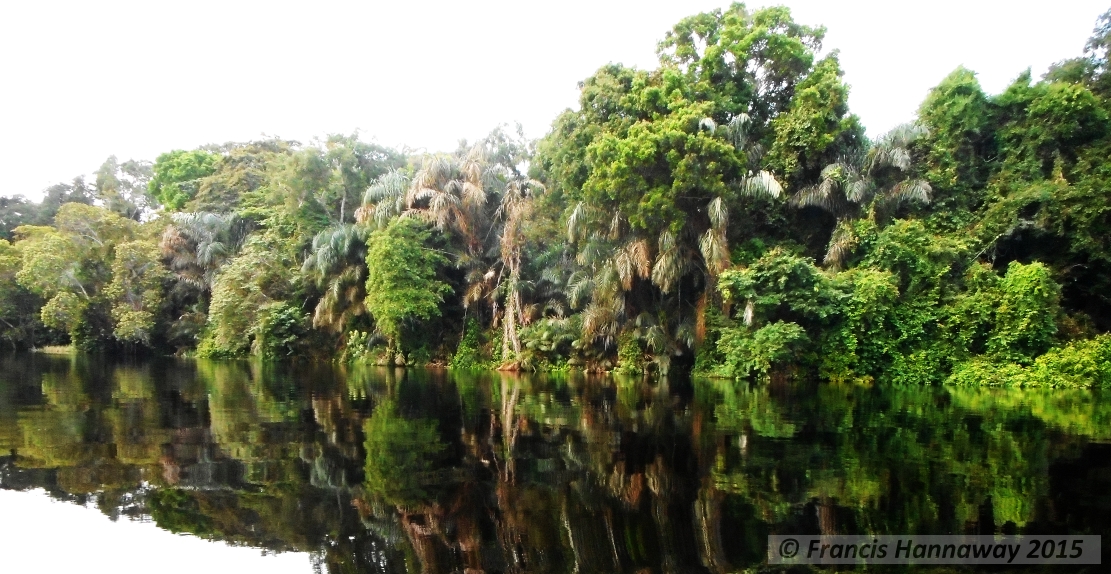
During the day, of course, the landscape - rainforest reflected in the river's mirror - was spectacular. At night, the stars were dazzling and the river illuminated by the first quarter of the new moon - which on the Equator sits on its back like a smiling mouth. Most of river is surrounded by the rainforest’s towering trees, miles from any human habitation, and the sounds of the forest animals, cricking, booming and hooting, echo across the water.

I arrived, exhausted, at 7 am, after 25 hours cramped up in a canoe. What I came to realise was that if Basankusu was so difficult for me to get to, the people who live here must also feel so very isolated. Goods arriving to be sold in the market are limited because of this isolation and produce from people’s market gardens is difficult to send to markets elsewhere. Once you are here, there is very little contact with the outside world.


I was met by Fr John Kirwan MHM, who made me very welcome.


Holiday in DR Congo - (Part 2) Mbandaka to Kinshasa by plane

I arrived in Mbandaka on Tuesday, after travelling by river the 500 km from Basankusu. Mbandaka is a large town in the west of the Democratic Republic of Congo; it’s right on the Equator and on one of the world’s biggest rivers, the River Congo.

After checking in at the sisters’ maison de passage and then getting a better offer at the Brothers of the Sacred Heart, I called my contact who was buying a plane ticket for me, Alain. He said he would call by the next day with the ticket. Engineer Dally, who I’d travelled with, called me out for a drink and the next thing I knew we were speeding through the streets of Mbandaka on the back of a taxi-motorbike. Clarisse Iwewe, the daughter of a friend and originally from Basankusu, joined us and we chatted, relaxed and in general passed a pleasant evening together.


Brother Sylvain in Mbandaka. He is a religious Brother of the Sacred Heart.

Monday, I had a traditional breakfast with the brothers – I’m saying “the brothers” as if there were lots of them; in fact, there was only one brother, Brother Sylvain, and his aspirant. … so, just two of them. Breakfast was rice pudding as a watery sort of porridge with some ground peanuts mixed in – fresh bread was there to dunk into it … just the ticket!

Engineer Dally had been given a place just across the yard in the diocesan procure, but food wasn’t included. I joined him across the street in a little diner attached to the Hotel Karibu (which means welcome in Swahili). It overlooked the River Congo and so we enjoyed the view, with more canoes arriving, just like ours from yesterday, and bigger boats, too. I decided not to take photos of the river – it might have attracted the unwelcome attention of the authorities looking for money.

My plane-ticket arrived, delivered personally by Alain, and then Dally and I went out for lunch, calling in on two of the Sisters of St Theresa from Basankusu our way. Lunch was at a restaurant, set in a gazebo, called the Three Sisters. It was very nice, with large portions of grilled fish, cassava leaves and semolina (fufu); the price was low, too, compared to what we would have to pay in Kinshasa. A steady stream of hawkers wandered through the gazebo … very much at home and known by the women serving the food. They sold a variety of things, one sold shoes while another sold fruit, and so on …

" It was a relaxing hour or two, doing nothing except talking. I brought my camera out and Clarisse took great pleasure in posing for photos with us all." - Clarisse posing with Engineer Dally


When we got back, we sat and chatted in front of the brothers’ place. It seemed a bit strange to see five or six cows wandering about in the grounds in front of us … a legacy, no doubt, of the missionaries that established the parish. Clarisse Iwewe came to visit but took some persuading to walk past the cows. I don’t think she’d ever seen such creatures before. It was a relaxing hour or two, doing nothing except talking. I brought my camera out and Clarisse took great pleasure in posing for photos with us all.

Tuesday morning, Brother Sylvain kindly knocked on my door at 5:45 so I wouldn’t miss 6 o’clock mass at the cathedral (thanks ...!). After mass, I examined my ticket and noticed that the price written on it said $180. I’d sent $285, so I phoned Alain to see about getting the difference refunded. He told me not to worry and he would sort it out at the airport. Hmmm … I smelled a rat.

Engineer Dally had finally got a ticket paid for by Basankusu Diocese and would be on the same plane as me. Mademoiselle Jeanne-Marie Abanda, who has helped me before when I’ve passed through Mbandaka, said she would send a jeep to take us both to the airport in the afternoon. Jeanne-Marie is a lay-person who runs the Caritas office in Mbandaka.

After bags were packed and goodbyes had been said, we set of fashionably late for the airport, which is only twenty minutes’ drive away.

The usual mayhem began in earnest. Soldiers on the gate started to demand money for entering the airport grounds – one of our co-passengers was an army officer and he argued that Caritas didn’t need to pay. They eventually let us pass. At the door to the airport a group of young men clambered about and started to take my bags. “I’ll carry my own bags!” I commanded. One of the group turned to face me … it was Alain, the one who’d got me my ticket. I relaxed a little and allowed them to continue.
We went inside the small airport building. 

The room was absolute bedlam. Passengers checking-in formed a heaving mass of bodies pushing towards the check-in desk. Voices were raised to create an overwhelming din and in the dizzying mêlée I found my passport, ticket and cabin-baggage being taken from me by Alain’s people. What is going on? I didn’t ask for anyone to give me special treatment here but I felt helpless to stop it happening. Sitting behind a trestle-table were five uniformed men from the RVA (Régies de voie aérienne), or airport police, no doubt looking for easy prey. 

Behind another trestle-table five uniformed health officials. Yellow Fever vaccination cards need to be shown on entry to the country, but someone with nothing better to do, in some government department, decided they would employ people to check the these cards at every airport. Congolese travellers didn’t seem to be asked, but in any case, Congolese people tend to have the vaccination card without having had the injection. They demanded 1,000 Congolese Francs for the privilege of looking at my card – I refused … I’d already paid airport tax, regional tax, tax within my ticket … and now they wanted more tax. They pulled a receipt book out of a drawer as if it was a novelty. I still refused and, as my ticket was taken in one direction by Alain’s helpers, and my case was taken in another direction, I tried to go through the door into the area for passengers. The door was guarded by a policeman. One of the health people called out to the policeman, “Stop him, he hasn’t paid!” I smiled at the policeman, said, “Excuse me,” and he held the door open for me, ignoring the official.

Outside the building, facing the runway, there was an area of plastic chairs and tables as an impromptu café area. I sat down and was soon joined by Dally. One of Alain’s workers called me back into the building to see the dreaded DGM, or immigration officials. I waited a while and was finally called in and asked to show my passport and visa, to give my occupation – missionary – and reason for travel – holiday – and that was that.


Kishasa: Visiting an old friend from Basankusu, Cathy, who now lives in Kinshasa. Here with her parents who had come to stay for a while.

We sat outside for another thirty minutes or so. One of Alain’s people came and explained that they’d taken $30 for mine and Dally’s airport tax; he returned $20 and said there was another $50 to come … but they would return that through a transfer agency on Saturday. (Saturday came and went … I’m still waiting)

Apart from the near stampede getting onto the Airbus 320, and cringing when I was called to the front of the queue ahead of everyone else, the flight was to a high standard. They even had an alternative snack for non-meat eating me … a cheese baguette. We landed in Gemena first and then travelled back down the country to Kinshasa, where Nene had arranged for a driver to meet me.


" ... I was welcomed into the civilised world of high precision wonky and ill-fitting fixtures and a sophisticated level of poor workmanship in all things. The big city is part decaying colonial town, more than half shanty-town, and a growing proportion modern buildings. "

Having left the forest behind, I was welcomed into the civilised world of high precision wonky and ill-fitting fixtures and a sophisticated level of poor workmanship in all things. The big city is part decaying colonial town, more than half shanty-town, and a growing proportion modern buildings. There’s no McDonalds yet and pizza is only available to the select few at $18 a shot. But this is also the place where I have a growing number of friends: friends from years ago in Basankusu, and friends I’ve made in recent years through my work for our environmental group. Somehow I feel at home here and intend to relax and have some fun.


Plenty of work ... even on holiday. Here, RCEN, the journalists Civil Society collective have their national meeting at our Kintambo office.

Very soon, however, I would find myself at work again. Procuring visas for visiting UK journalists from Breakthrough Media, teaching our environmental group members to use conditional formulas in bookkeeping spreadsheets (don’t ask!), and helping to procure wheelchair-bikes for disabled people back in Basankusu, would be jobs I would find myself doing over the first few days of my stay.
There will still be time over the next seven weeks to relax. Eating in an open-air restaurant in the shade of a palm-thatched shelter … perhaps on the banks of the River Congo (the same river that passes through Mbandaka), perhaps with a glass of beer … or two, is all to look forward to.


I’m on holiday, alleluia!


Monday, 13 July 2015

Holiday in DR Congo - (Part 1) Basankusu to Mbandaka by river

I decided to take a holiday away from my activities in Basankusu, where I've been living since the end of last year. Basankusu is just above the Equator in the Democratic Republic of Congo. I would go to Kinshasa, the capital city of the Congo, and recharge my batteries.
[click on the photos to see them full screen]

Basankusu sits in a beautiful unspoilt part of the Congolese rainforest; its inhabitants’ lives bound in a strong Christian faith and equally strong ties to their families and wider clan. Extreme isolation and lack of any form of recognisable road system, coupled with endemic corruption and incompetent governance, result in a lack of commercial endeavour, poor education and poor healthcare, fuelling in turn the downward spiral into poverty.

There is an airstrip. They tell you it’s an airport. I remember a small plane landing there two months ago – only for deliveries, not for passengers.

Getting out of Basankusu has become a real problem.


I was very pleased to be told on Wednesday that one of the professors from our “university” (every town claims to have a university these days) was making a trip in his own large wooden canoe, complete with outboard engine. I would travel 500 km, beginning in Basankusu, along the River Lulonga and the River Congo, to Mbandaka. Mbandaka is recognisable as a town. Quite a few of the roads are tarmacked, and large aeroplanes land at the airport, three times a week, for Kinshasa. The town sits right on the Equator – so passing this point, I would pass from the Northern to the Southern Hemisphere  The river journey would take about 20 hours – starting Saturday at 3 pm and arriving early afternoon, Sunday. I would stay in Mbandaka for two nights before flying to Kinshasa on Tuesday. The man in charge of construction at the new Basankusu Cathedral, Engineer Dally, would make the journey with me.

Although it would be a snug fit, the canoe could accommodate about 18 people. The driver sits at the back with the outboard engine, and someone sits at the front to navigate. The central part of the canoe would have a structure over the middle to hold a tarpaulin – which would not only protect us from the possible tropical rain, but also from the blazing sun. We took our own chairs to sit on during the voyage.

The weather was perfect on Saturday: not much sun, now and then a few spots of rain … but nothing serious. The river generates a steady breeze – I don’t think it’s caused by the movement of the boat, but by the river itself. Even though the temperatures in Africa are always high, this persistent flow of air – and the fact that we were just sitting on a chair for so long – has a gradual cooling effect. Eventually, you start to shiver … hats, jackets, and lengths of cloth are pulled out of bags, as passengers try to wrap up against the cold. I was fortunate enough to have a waterproof coat and trousers, but still needed to pop another t-shirt over my shirt, to keep warm.

The scenery along the river is always spectacular. Lush green vegetation bordering the river is reflected in the pristine water. Small canoes appear from time to time – a man standing up and fishing with a net, an old woman with a canoe full of firewood, a young mother sitting in the stern with a very young child up front in the bow.


We passed Bonkita – 18 km from Basankusu. It’s where I teach each Monday at the minor-seminary. Then, we came to Bokakata and took a comfort break. We met one of the carpenters from the procure in Basankusu. He’d hurt his leg at work, and was recuperating in his home village. Everyone seemed to know him – myself included – and he took us to see a little bar he ran there. There was the distinctive aroma of Pastisse … that was the first time I’d seen that in Congo, and here it was, in a tiny village!

The journey continued. We passed a lot of Ngandas – fishing villages, made from bamboo and palm leaf thatch. Often these temporary houses are built on stilts to accommodate the different levels of the river throughout the year. We saw a larger boat going up-river and a much larger one, crowded with people and piled high with their goods. Night-time came and eventually went, small parcels of food emerged from people’s bags, quiet chatter, then the smell of toothpaste and the sound of teeth being given their morning once-over, and finally the tranquillity of the journey was broken by ring-tones on full volume … as we picked up the phone signal from Mbandaka.

Approaching Mbandaka, we started to notice Japanese Hyacinth here and there in the water. At one point we had to really slow down to avoid it. It’s an attractive plant with a pretty pink flower, and was first introduced into ornamental ponds in people’s gardens. Since finding its way into the river, it has become a menace. Not only can it become tangled in the propellers of passing boats, but, when present in large quantities, it blocks sunlight and causes the demise of everything in the river.

My worry about arriving somewhere new in Congo is the arbitrary nature of the official authorities. There only seems to be one rule – if you’re identified as a foreigner (being white is the give-away) you should pay some money. The level of greed by local officials is the only variation to this. Movement between towns, especially of foreigners, is strictly monitored in Congo. We pulled in alongside another large wooden canoe and started to unload our things. Things were going smoothly when a woman holding a pen and an exercise-book approached me and asked for my papers. She copied my name and visa details from my passport, asked me where I would be staying in Mbandaka and said that everything was in order … and that was all. What? No bribe to pay? No extortionate demand for payment? In fact quite a warm, courteous welcome … what’s the world coming to?

Engineer Dally and I carried our chairs and bags up the hill from the riverside to the road. We negotiated a price with three motor-bike taxis. One carried my big wooden armchair and suitcase, the other two would carry us and our smaller bags.

Mbandaka Cathedral, the diocesan procure, the Sacred Heart Brothers, and the Sisters of the Holy Face of the Infant Jesus, all have their buildings in one compound. We arrived at the sisters’ convent, where I intended staying, and where Engineer Dally said he’d leave his things until he got a room in a hotel. The sisters were very welcoming and installed me into a small room with shower and toilet. The shower worked, but I’d need buckets of water to flush the toilet. $25 US per night – no food
The sisters had a little shelter outside the main building, that’s where Dally and I shared the bits of food we’d brought along – my offering was literally loaves and fishes as Mama Didi, our cook in Basankusu, had packed me up with a Tupperware container of grilled fish and a couple of loaves of bread. Dally had some cassava bread – the starchy local staple … and I also had some roasted peanuts. Someone went to buy beer for us and we were set for our feast!

After eating, I phoned Brother Fuila, who’d made the same journey as us a few days before, but who was now in Kinshasa. He said I should put my chair and waterproof tarpaulin in at the brothers’ place for safe-keeping until my return from Kinshasa in two months’ time. I went across the brothers’ and Dally, on advice from Basankusu diocese, went to find a room at the procure.

Brother Sylvain was very welcoming. He found a room to store my chair and tarp. He also told me that they were expecting me to stay with them, and, no, they wouldn't charge me a penny, and yes, of course, I would eat with them. It didn’t take me long to move my stuff … and he and his student proved to be very good company over the next couple of days in Mbandaka.


Tuesday, 9 June 2015

A sad story about a young mum-to-be in Basankusu, DR Congo

I first met Alain in 2013. I was visiting Basankusu during my time doing some work for an environmental group in Kinshasa. He introduced me to the staff and children in one of the schools for orphans here in Basankusu, for which he is the coordinator. When I returned at the end of last year, to take up my post with Mill Hill Missionaries, he took me to visit another three such schools and explained to me the realities of living with poor health-care, poor sanitation and a poor diet. 

Judith Bondjembo with Francis Hannaway 
(2015) 

“Simple complications, which could be easily dealt with in Europe, can quickly become fatal here in the Congo,” he told me. “That’s why we have so many orphans … orphans who have no means to pay school fees. So, from within our community we’ve founded our own schools for them … all run by volunteers.”

Sometimes he talked about his girlfriend and how he hoped to save up enough to have a wedding.

I became concerned about three weeks ago when he told me that his girlfriend was pregnant and had been taken to hospital because, they said, “her blood was finished”. We went together, Alain, Judith from the nutrition project and myself. The Catholic hospital is a great addition to Basankusu’s main hospital – but neither facility could be said to be top of the range – but they do their best.

I entered the small ward. Metal framed hospital beds had been donated by a government minister … whether or not they were new, I couldn’t tell. Alain’s girlfriend looked very ill, almost lifeless, pale and extremely thin. Family members sat on the beds around and chatted. She had some sort of drip attached to her arm.

Eventually, a nurse came in. He berated the family for not opening the windows to let some cool air in. The way he acted and spoke told me that he’d had a few drinks … but was still keen to set up the transfusion. People were sent left and right to buy bits of equipment – the doctor was away and the pharmacy was locked. I paid the money for the transfusion and the woman’s aunt went off to have her blood taken and returned with the nurse holding a huge bag of blood. They decided to use the same line that had delivered the drip and … after some of the blood had been squirted onto the floor, I made my excuses and let them get on with it.

The next day, she was sitting up in bed, looking a lot better, and saying she felt a lot better. I teased Alain about her weight. “She’s your wife, Alain, and she’s pregnant. She’s eating for two now … It’s you responsibility to make sure she eats plenty. I want to see her becoming fat. What do you think? Can you do something about it? No more running around with your orphan schools – stay at home and feed your wife … even if she refuses.” The older women all nodded their heads in agreement.
She had a blood condition called Sickle Cell Anaemia. The red blood-cell, which are normally round, are misshapen – often looking like a crescent or sickle shape. They prevent the malaria parasite from entering inside them, and it’s perhaps for this reason that the condition has been able to persist in the population. Unfortunately, these cells are fragile and result in severe anaemia. It is not wise to become pregnant with this condition.

A few days later, Alain phoned to say that they were leaving the hospital and going home. I was pleased to hear that she was picking up. I saw Alain several more times at the nutrition project, including at Judith’s house where she was feeding malnourished twins, and at his schools for orphans. He told me that his girlfriend asked after me and I thought no more about it.

So, Saturday just gone, I was discussing the nutrition project accounts with Judith at my house, when a young man arrived on a bicycle. He said that Alain had sent him and could I come quickly. I asked what the matter was and he said that Alain’s girlfriend was dead.

We were obviously shocked. I’d thought that everything was going alright. I took the Toyota Landcruiser, our standard all-terrain vehicle, and set off along the rough dirt tracks that are referred to as roads. The young man – perhaps Alain’s brother – left the bicycle in our garage because the dead woman’s family had threatened to take all his possessions and to beat him up. Along the road we stopped to pick up others who were going to the wake. They were carrying various foodstuffs, a sack of sugar, palm-nuts, and vegetables – very soon the car was full. The wake was in a newer part of Basankusu and the roads twisted and turned and were certainly never made with cars in mind. Branches bounced on the top of the car, long grass obscured the track and hedges and fences impinged its borders, scraping down the sides of the car.

A double-bed, made of wood, displayed her body, swathed in sheets and wearing a surgical mask and cap – just the upper part of her face was visible. An older woman was sitting beside her on the bed – I’m assuming it was her grandmother. Alain was sitting on the ground, wearing shorts and a torn t-shirt – which is the custom. He was wailing uncontrollably – as were many of the other mourners. Two Sisters of St Theresa, from our local community, who knew her well, were there when I arrived … a few more arrived later and led hymns and prayers.

I crouched down next to him and held his hand and his head. Words were not necessary. After a while I was led to a wooden chair where I sat down.

Our day-watchman came over to me and more or less proposed that I should pay for all the refreshments for all the mourners. The idea of Europeans as having endless resources surfaced again.  I nodded as he spoke … I would make a gesture of willing but make sure it went into Alain’s hands.
In the true spirit of a wake, some people stayed there for the night and others returned the next morning. The next day was Sunday. Fr Stan had been called out to the river, at 2 in the morning, to collect two religious sisters from Djombo who had arrived by canoe. The two sisters knew the dead woman very well and Fr Stan was given strict instructions not to tell them anything until they’d at least had some sleep.

Fr Stan drove me in the Landcruiser and we snaked around the narrow lanes back to the house where the wake was. A group of young men, standing against the rickety bamboo fence to the house, turned when they saw the car. “Take your car away!” they yelled. “We don’t need you here! We’ll carry the coffin!” There was, of course, no problem with them carrying the coffin, but the rude and arrogant attitude at the arrival of a priest had already started – possibly fuelled by lack of sleep, and probably by alcohol, too.

Alain’s brother had visited me early that morning and asked if I could pay the burial costs - £50. I later heard that they’d collected half of the costs and when they half walked, half carried Alain alongside our car, I was happy to give him the other £25. I was pleased to make a contribution but also pleased that friends and relatives hadn’t depended on me for all of it.

The wailing began in earnest as the sisters climbed into the car. Some were from the same village as Alain’s wife (she was from Baringa), some had got to know her while she lived and studied in Basankusu. Crying and wailing, is contagious and soon the whole four-wheel-drive was filled with the spirit of sadness and mourning. They carried the coffin and jogged along the lane in step - like you used to see them doing in demonstrations in South Africa. The up-step is quite high – but the speed that they travel is quite slow … it has a sort of bounce to it, and everyone is in step. Chanting accompanies the jogging – I was oblivious to the words, but it seems they incite all sorts of things including parts of the body which shouldn’t normally be mentioned in polite company.

We made a stop at her college for a few prayers and then continued the slow crawl behind the crowd to the cemetery area – which is just some grassy, overgrown land on the edges of Basankusu at the side of the road. Some graves had do-it-yourself concrete dressing and headstones … others had obviously imported modern gravestones from Kinshasa.

Fr Stan took the car a little way past the gathering and turned it round in preparation for the return journey. The sisters got out and we watched the coffin being lifted high above the people’s heads the grave.

Suddenly, there was a commotion. The grave was far too small. It was neither long enough, nor wide enough. It was very obvious that the grave-digger wanted a higher fee than he’d received. The youths who’d carried the coffin were also in ebullient mood. They chanted louder and louder and blocked our exit with the coffin. At one point, one of them sat down on the coffin – but at least was persuaded to get up again by some other mourners. They also started to demand money … and so our day-watchman tried to intervene. I saw him trying to appease them and then look towards our car. “This is where they ask us for more money,” I said to Fr Stan. The watchman’s attempt was met with a swift rebuttal. “This lady was a friend of the sisters,” he said. “We have already made a generous contribution, but it’s really not us you should be asking.”

Somehow the matter was resolved and the poor young woman’s remains were finally laid to rest.
Today is Tuesday, The mourning is still continuing. Today or tomorrow they expect the arrival of the dead woman’s family members from Baringa, which is 120 miles away. They will most likely have set off walking on Sunday.

Alain can expect to be menaced again by these new mourners – after all, he is seen as the one who caused the situation of her death.

 But eventually things will calm down.